Every Toll Plaza Knows Your Speed — And Your Cruise Control Is Helping
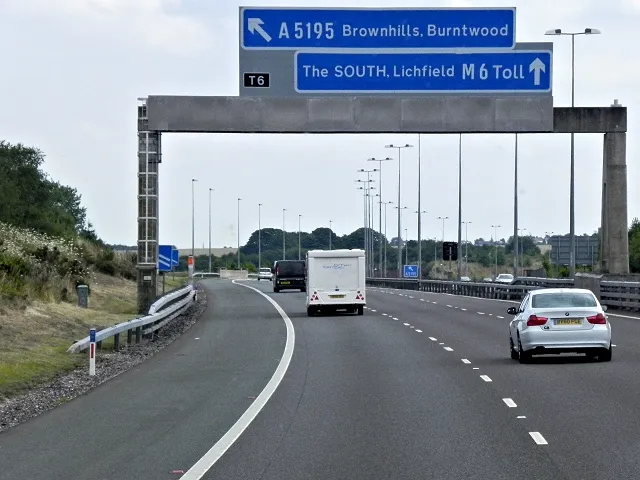
Photo: David Dixon , CC BY-SA 2.0, via Wikimedia Commons
Let's start with something most drivers have never considered: when you roll through a modern toll plaza at a steady 65 mph with your adaptive cruise locked in, you're not just paying a fare. You're generating a data point. Actually, you're generating several.
Your entry time. Your exit time. Your calculated average speed. Your transponder ID, which links back to your account, your vehicle registration, and in many states, your billing address. And increasingly, your vehicle's connected systems are communicating with roadway infrastructure in ways that feed even more granular data back into networks you've never agreed to in any meaningful way.
This isn't a conspiracy theory. It's the current state of connected highway infrastructure in the United States, and it's moving fast.
How Toll Systems Have Evolved
The old model was simple: stop, pay, go. E-ZPass and similar RFID-based systems changed that in the 1990s by letting you roll through at low speed without stopping. Convenient, yes — but also the beginning of a shift toward continuous vehicle tracking on toll corridors.
Today's all-electronic tolling (AET) systems, now standard on major toll roads across Florida, Texas, Illinois, and much of the Northeast, don't require you to slow down at all. Overhead gantries read your transponder or photograph your license plate at highway speed. The system logs your entry and exit, calculates your toll based on distance traveled, and bills your account.
Here's where cruise control enters the picture in an unexpected way. Transportation data researchers have noted that vehicles maintaining steady, consistent speeds — exactly what cruise control produces — generate cleaner, more complete data records as they pass through these gantry systems. Transponder reads are more reliable. License plate images are sharper. The system captures more usable data per vehicle.
In practical terms, cruise control makes you a better data subject.
Dynamic Pricing and What It Knows About You
Managed lanes — those express or HOV lanes with variable tolls based on real-time congestion — take this a step further. Systems like the ones operating on I-66 in Virginia, I-405 in Washington state, and the 95 Express Lanes in South Florida use real-time speed and volume data to set prices that can change every few minutes.
These systems are constantly collecting speed data from transponders, connected vehicle signals, and roadway sensors to model traffic flow. Your vehicle's speed — again, extremely consistent when cruise control is engaged — feeds directly into those models.
Some newer implementations go further. Vehicles equipped with V2I (vehicle-to-infrastructure) communication systems, a technology that's being piloted in several U.S. states, can transmit speed, heading, and position data directly to roadway management systems. Several major automakers have already integrated V2I capability into production vehicles. If your car has it, and you're on a corridor with active V2I infrastructure, your cruise control speed is being transmitted in near real-time.
"Most drivers have no idea their vehicle is communicating with the road," says one transportation technology consultant who works with state DOTs on connected corridor projects. "The conversation about consent hasn't kept up with the deployment."
The Privacy Landscape (It's Complicated)
So who owns this data, and what are they doing with it?
The short answer is: it depends heavily on which state you're in, which toll operator is involved, and whether you're talking about transponder data, license plate data, or connected vehicle data. These are three different legal categories with three different sets of rules — and they don't always align.
Transponder data collected by toll authorities is generally governed by state law. Most states have some form of privacy protection for E-ZPass and similar records, but enforcement is inconsistent and data-sharing agreements with third parties — including law enforcement, traffic analytics firms, and in some cases insurance companies — vary widely.
License plate data collected by toll systems sits in an even grayer zone. Automated license plate reader (ALPR) data has been the subject of ongoing legal battles across the country, with some states restricting retention periods and others placing almost no limits on how long the data can be kept or who can access it.
Connected vehicle data is the newest frontier and arguably the least regulated. The FTC has issued guidance, but comprehensive federal legislation governing vehicle data collection remains absent as of 2025.
What Privacy-Conscious Drivers Should Actually Do
None of this means you need to pull your transponder and start paying cash at every toll booth. But there are practical steps worth taking if you care about limiting your data footprint on toll corridors.
Check your toll account's privacy settings. Most E-ZPass and SunPass accounts have settings that control data retention and sharing. They're buried, but they exist. Look for options to limit how long transaction history is stored.
Understand your state's laws. A quick search for your state's transponder privacy statutes will tell you a lot. States like New York and California have stronger protections than others. Knowing your rights matters.
Be aware of V2I capability in your vehicle. If you bought a new car in the last two to three years from a major manufacturer, check your owner's manual and connected services settings for any mention of V2I or vehicle-to-infrastructure communication. Some can be disabled.
Consider the managed lane trade-off. Those variable-rate express lanes are genuinely useful, but they're also the most data-intensive toll infrastructure on the road right now. If privacy is a priority, sticking to standard lanes reduces your exposure.
Use cash where it's still available. Yes, it's increasingly rare. But on roads where cash payment is still an option, it remains the most private way to pay a toll. You'll slow down, you'll be mildly inconvenient, and you'll leave a much smaller data trail.
The Bigger Picture
Cruise control is a tool for smoother, more efficient driving — and it does that job well. But the connected highway ecosystem it increasingly operates within is one most drivers haven't been introduced to in any honest way.
Your consistent speed, your predictable behavior, your transponder pinging gantries from entry to exit — all of it is feeding systems that are growing more sophisticated every year. That's not inherently sinister. Better traffic data does produce real benefits: fewer accidents, smarter congestion management, more responsive infrastructure investment.
But the exchange should be transparent. You should know what your car is sharing, with whom, and under what terms. Right now, for most American drivers on most toll roads, that transparency simply doesn't exist.
Drive smarter. That means knowing what the road knows about you.