Black Ice, Bad Sensors, and the Cruise Control Habit That Could Get You Killed
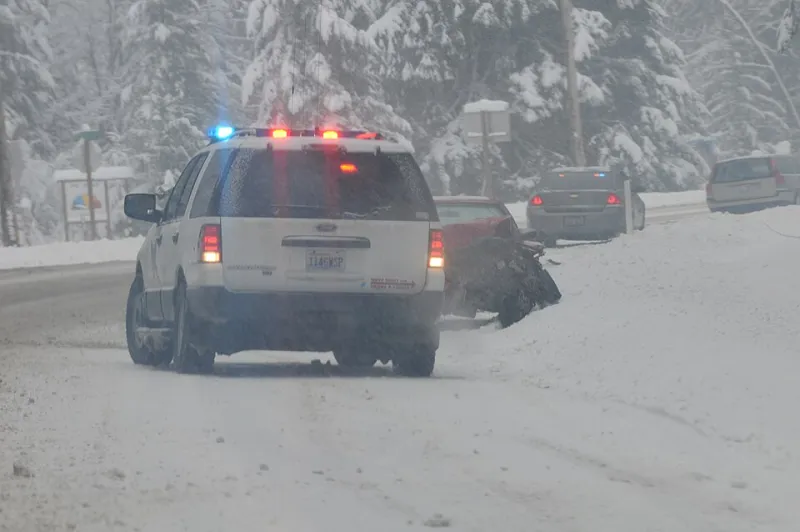
Photo: D Coetzee, CC0, via Wikimedia Commons
Every winter, drivers in northern states, mountain corridors, and the unpredictable mid-Atlantic region make the same mistake. The highway looks clear. Traffic is moving. The temperature is hovering right around freezing but the pavement seems dry. So they set the cruise, lean back, and let the system take over.
Then a bridge deck appears. Or a patch of black ice in the shadow of an overpass. Or a stretch of road that was salted six hours ago and has since refrozen.
What happens next is fast, and it is not the car's fault. It's a fundamental mismatch between what cruise control was built to do and what winter roads actually demand.
The Core Problem: Cruise Control Doesn't Feel the Road
Regular cruise control — the kind that just holds a set speed without any adaptive capability — operates on a simple feedback loop: compare current speed to target speed, apply throttle or light engine braking to close the gap. That's it. The system has no awareness of road surface conditions. None.
When your drive wheels hit a patch of ice, they can lose traction in a fraction of a second. On a dry road, that brief slip is usually imperceptible — the tire grabs again almost immediately. But when cruise control is active, the system interprets the resulting speed drop as a reason to add throttle. More throttle on a slippery surface equals more wheel spin. More wheel spin on ice equals less control, not more.
This is the scenario that highway safety researchers have documented repeatedly: a driver on a winter highway, cruise engaged, hits a slick spot, and instead of naturally lifting off the throttle the way a human foot would, the system pushes power into the wheels at exactly the wrong moment. The vehicle breaks loose. The driver, who wasn't actively managing the throttle, is caught completely off guard.
Adaptive Cruise Control: Better, But Not Immune
Modern adaptive cruise control (ACC) adds radar and camera sensing to the equation, which helps with following distance and speed matching to traffic ahead. But it doesn't solve the traction problem — and in some ways, it creates new ones.
ACC systems are calibrated to operate on surfaces with predictable friction coefficients. The braking algorithms assume a certain level of grip. On wet pavement, most systems handle this reasonably well because the degradation is modest and gradual. On ice or packed snow, the friction drop is severe and often sudden, and ACC braking responses can be both too aggressive and too late.
There's also the sensor issue. Snow, road spray, and road salt accumulation on radar sensors and forward cameras are genuine operational hazards. Salt spray in particular creates a film on optical sensors that reduces detection range and accuracy. Radar units can be physically blocked by snow buildup in front grilles. Most modern vehicles will display a warning and disable ACC when sensors are compromised — but that warning sometimes comes after the system has already made a bad decision.
The ABS Interaction Problem
Here's a wrinkle that doesn't get nearly enough attention: the interaction between cruise control and your antilock braking system during a winter traction event.
ABS is designed to prevent wheel lockup under hard braking, allowing you to steer while stopping. It does this by rapidly pulsing brake pressure to individual wheels. On dry pavement, it's extraordinarily effective. On ice, it's still better than locked wheels, but stopping distances can be dramatically longer — sometimes two to three times what you'd experience on dry asphalt.
When cruise control is active and a driver suddenly needs to brake hard — because the car ahead stopped, or because they've hit ice and are trying to regain control — the transition from "system managing throttle" to "driver managing emergency braking" introduces a reaction time gap. The driver has to first register the problem, then disengage cruise (or apply the brakes, which on most systems automatically cancels cruise), and then modulate braking appropriately for the surface.
On ice at 65 mph, that extra half-second of reaction time covers roughly 50 feet. Fifty feet on black ice is the difference between a close call and a collision.
Road Salt: The Invisible Complication
Salt is the American highway system's primary tool for managing ice, and it works reasonably well — until it doesn't. The problem with salt-treated roads and cruise control is that road conditions can change dramatically within short distances.
A freshly salted section of interstate might offer near-dry pavement grip. Half a mile later, where the salt was applied hours earlier and temperatures have dropped, you might be on a surface that's effectively glazed. The visual difference is minimal. The traction difference is enormous.
Cruise control has no mechanism to detect this transition. It's holding speed regardless of what the surface is doing. A driver actively managing the throttle will often feel a subtle change in steering feedback or hear a slight change in tire noise that prompts them to ease off — an intuitive response that no current cruise control system can replicate.
What Safer Winter Highway Driving Actually Looks Like
The practical guidance here is straightforward, even if it's not what most drivers want to hear.
Turn it off when temperatures drop below 35°F. You don't need to wait for visible ice. Below 35, bridge decks, overpasses, and shaded stretches can be frozen even when the surrounding road looks fine. That's the threshold where the risk-reward calculation on cruise control shifts decisively.
Know your road's salt history. Freshly salted roads in active treatment are generally safer than roads that were treated several hours ago and have experienced further temperature drops. Pay attention to highway advisory signs and state DOT road condition apps — most states have them now.
Increase following distance manually. Even if you're not using cruise, driving on winter roads at normal following distances is a mistake. Three to four times your normal dry-pavement gap is a reasonable target.
Keep your sensors clear. If you do use ACC in marginal conditions, check your front grille, radar sensor covers, and camera lenses before you drive. A quick wipe can make a real difference in system reliability.
Trust your instincts over the system. If you feel something off in the steering — a slight vagueness, a hint of float — that's your nervous system detecting a traction change before your conscious mind has processed it. Honor that signal. Ease off. The cruise can wait.
What the Next Generation Needs to Solve
The honest assessment of current technology is that no production cruise control system — adaptive or otherwise — is truly ready for American winter driving conditions. The next generation of systems will need real-time road surface friction estimation (several automakers are working on this using wheel speed sensor data and predictive algorithms), better sensor heating and self-cleaning capabilities, and tighter integration with traction control and stability systems so that a detected slip event immediately and automatically suspends cruise operation.
Until that technology is production-ready and proven, the safest winter driving tool you have is still the one attached to the end of your leg.
Use it.